
Hands-Off Property Management for Landlords in Oman
· 16 min read · By Raheem Wyne

Can a rental property in Oman run smoothly without your daily attention? Yes, property management without landlord involvement can delegate recurring operations while ownership and informed oversight remain yours. The distinction matters: professional management can reduce routine administration, but it doesn’t remove your role in setting priorities and reviewing decisions.
For landlords balancing work, travel, and maintenance needs, ARW Trading provides property management for owners and landlords across the country. Its rental management includes finding tenants, collecting rent, coordinating building maintenance, and following up on property needs. These responsibilities can help keep routine property operations organized when you’re not on site.
This article explains which recurring tasks can be handled on your behalf, what you may still need to oversee, and how professional management compares with direct owner involvement. It also covers what to agree and document before delegating, including the scope of authority, decision-making arrangements, and the reporting you expect. The aim is a workable level of involvement, not a promise of complete disengagement.
Key Takeaways
- Define “hands-off” as delegating recurring rental tasks, not transferring ownership or giving up oversight.
- Identify which duties can be delegated, including finding tenants, collecting rent, and following up on maintenance needs.
- Compare self-management with professional management by considering the time required for tenant communication, maintenance coordination, and administration.
- Set approval boundaries, communication expectations, and review arrangements in writing before delegating.
- Property management without landlord involvement can reduce routine work while leaving important decisions and oversight with you.
Property Management Without Landlord Involvement: What Does “Hands-Off” Mean?
In Oman, delegated property management can reduce a landlord’s routine involvement, but it doesn’t transfer ownership or remove the need for informed oversight. The landlord and property manager agree on which recurring tasks the manager will handle and which decisions require the owner’s direction.
Hands-off property management is an agreed delegation of day-to-day rental operations, not a transfer of property ownership or decision-making authority. This distinction is useful for landlords deciding whether to manage tenant and property matters themselves, particularly when work, travel, or distance makes regular coordination difficult. The phrase “hands-off” describes the owner’s level of involvement in operations, not a guarantee that the property will need no attention.
What landlords usually mean by hands-off property management
Most landlords seeking a hands-off arrangement want fewer routine calls, messages, and administrative tasks. They may want a manager to handle tenant enquiries, coordinate follow-up on property needs, and keep recurring matters moving, while the owner receives updates and remains available for decisions within an agreed scope. Reduced day-to-day contact is not the same as no oversight.
The scope should reflect the owner’s instructions. A manager may be authorized to carry out specific operational tasks, while choices with a broader impact can remain subject to the owner’s direction. For example, following up on a maintenance need is an operational responsibility; deciding how to respond to a substantial or unexpected issue may depend on the authority and approval process agreed in advance.
That is why property management without landlord involvement should be understood as a defined working arrangement rather than a promise of complete disengagement. General roles and responsibilities are outlined in this Property management overview, but the practical scope for a rental property depends on the agreement between the owner and manager.
What professional management does not change
Delegating operations doesn’t make the property manager the owner. The landlord retains ownership, while the manager carries out only the responsibilities assigned to them. Clear written instructions help distinguish routine execution from matters that the owner wants to review, approve, or decide personally.
Management also doesn’t guarantee rental income or investment returns. A manager can handle agreed rental operations, but this cannot ensure that a property will always be occupied, that rent will be received without interruption, or that costs and outcomes will match an owner’s expectations. Treating delegation as operational support, rather than a financial guarantee, keeps expectations realistic.
Finally, property management is not a substitute for legal representation or financial advice. Landlords considering a management arrangement should focus on its operational scope: what the manager will do, what requires owner input, how information will be shared, and how responsibilities will be documented. With those boundaries defined, an owner can reduce routine involvement while retaining meaningful oversight.
Which Rental Property Tasks Can a Landlord Delegate in Oman?
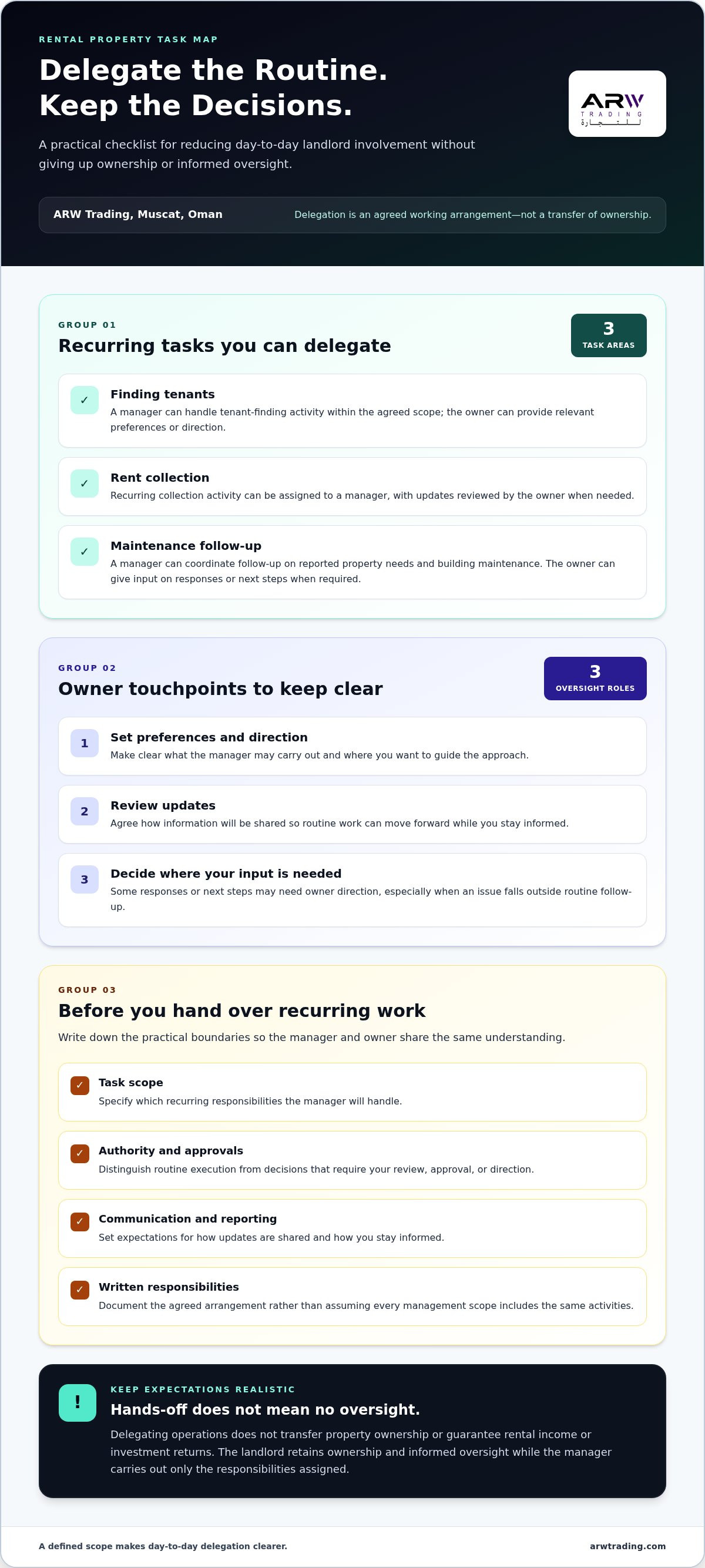
In Oman, a landlord can delegate recurring rental operations such as finding tenants, collecting rent, and following up on property maintenance needs. The exact division of work depends on the agreed management scope. A clear task-by-task understanding helps the owner reduce routine administration while keeping input on decisions that matter to them.
For landlords considering property management without landlord involvement, it is useful to separate execution from direction. A manager may carry out an assigned task, while the owner sets preferences or provides guidance on a matter that falls outside that routine work. The table below offers a practical starting point, not a substitute for recording the actual arrangement.
| Task | Manager role | Owner input |
|---|---|---|
| Finding tenants | Handle tenant-finding activity within the agreed scope. | Provide preferences or direction relevant to the property. |
| Rent collection | Manage the recurring collection activity. | Review updates and give direction on matters requiring owner attention. |
| Maintenance follow-up | Coordinate follow-up on reported property needs and building maintenance. | Provide input on the response or next steps where owner direction is needed. |
Tenant placement and rent administration
Tenant-finding can be delegated as a defined management task. This can reduce the owner’s direct role in coordinating the process, while the agreed scope clarifies what the manager handles and what preferences or decisions remain with the landlord. The arrangement should describe responsibilities plainly rather than assume that every management service includes the same activities.
Rent collection is another recurring operational activity that can be assigned to a manager. Delegation can reduce the owner’s need to handle each routine collection directly. It does not, by itself, establish a collection schedule, a particular follow-up procedure, or a guaranteed payment outcome. Those details should not be assumed unless they are part of the parties’ documented arrangement.
Maintenance follow-up and property needs
A manager can follow up on property needs and coordinate building maintenance as part of the agreed scope. For example, when a maintenance issue is brought to attention, the manager’s role may include keeping follow-up organized and communicating the matter to the owner where direction is needed. This separates coordination from the owner’s decisions about how to proceed.
Following up does not mean promising that a repair will be completed by a particular time or produce a particular result. The owner and manager should establish how updates and owner input will work without presuming approval limits, contractor standards, or emergency procedures that have not been agreed.
ARW Trading provides property management for owners and landlords in Oman, including tenant-finding, rent collection, and maintenance follow-up. Landlords can use ARW Trading’s property management information as a starting point for considering which recurring tasks to delegate and how to retain appropriate oversight.
Professional Property Management vs Self-Management: The Trade-Offs
Choosing between direct management and professional support in Oman depends on how much time and involvement you want to commit to routine rental operations. Self-management gives you direct control over tenant contact and follow-up. Delegation can shift agreed tasks to a property manager, while you retain oversight and make decisions that remain yours.
| Area | Self-management | Professional management |
|---|---|---|
| Time and administration | You handle recurring coordination and records yourself. | Agreed administrative tasks are handled by the manager. |
| Tenant contact | You serve as the direct contact for tenant matters. | The manager can handle tenant-related tasks within the agreed scope. |
| Maintenance follow-up | You organize follow-up on property needs directly. | The manager can coordinate follow-up as agreed. |
| Owner oversight | You stay close to routine activity and decisions. | You review updates and provide input on matters requiring your direction. |
When self-management may fit an owner
Self-management may suit an owner who has the availability and preference to handle tenant contact, rent administration, and property follow-up personally. Direct involvement can make it easier to stay close to each routine matter and decide how to respond as it arises.
The trade-off is responsibility for keeping those tasks organized. Tenant communication, rent-related administration, and maintenance follow-up need consistent attention, even when no single item appears complex. Self-management is not automatically cheaper or more effective; its suitability depends on the owner’s capacity, priorities, and willingness to oversee recurring details.
When delegation may better fit the owner’s circumstances
Professional management may be more suitable when an owner has limited availability, travels frequently, or prefers a defined operational point of contact. Delegating agreed tasks can reduce the need to manage each routine interaction personally. It does not mean the owner must surrender oversight or approve a management arrangement that leaves important responsibilities unclear.
The value of delegation depends on what the owner wants handled and what the manager is assigned to do. An owner may prefer regular involvement in decisions while delegating routine administration, or may assign a broader set of recurring tasks and review them through agreed updates. Overseas ownership alone does not determine which approach is right; availability, communication preferences, and the property’s needs all matter.
For landlords considering property management without landlord involvement, the practical question is not whether one model is universally better. It is whether the chosen arrangement gives routine work a clear owner while preserving a suitable level of review. Before deciding, consider which tasks you can reliably manage, where delays or interruptions are difficult, and which matters you want to remain directly involved in.
How to Set Up a Hands-Off Management Arrangement Without Losing Oversight
A workable arrangement starts with a clear division of responsibility. In Oman, landlords can reduce routine involvement without losing oversight by agreeing which tasks the manager handles, which decisions stay with the owner, and how updates will be shared. Record these expectations in the management agreement so both parties can refer to the same scope.
Use this sequence to establish the arrangement:
- List the recurring tasks. Identify the rental activities you want managed, such as tenant-finding, rent collection, and follow-up on property needs.
- Set decision boundaries. Note which tasks can proceed within the agreed scope and which matters require your direction or approval.
- Agree on communication. Specify what information you expect to receive, how it should be shared, and how the manager should request owner input.
- Schedule reviews. Choose a practical review rhythm for checking rental activity, maintenance follow-up, and whether the delegation still suits your needs.
Agree responsibilities and decision boundaries
A task-by-task schedule can make the arrangement easier to administer. For each activity, record the manager’s role, the owner’s role, and any point at which a decision must return to the owner. For example, maintenance follow-up may be delegated, while the owner specifies how decisions about a particular property need should be brought forward. Avoid relying on assumed approval limits or informal understandings.
Make the reporting process clear as well. State what details should be provided when a property need arises and how the manager should seek direction when an owner decision is required. The aim is not to create unnecessary paperwork. It is to make responsibility visible and reduce uncertainty when routine work intersects with an owner-led choice.
Keep oversight practical and proportionate
Oversight should give you a useful view of the property without recreating the daily workload you intended to delegate. Agree what updates matter to you and how often you will review them. Organized records of rental activity and property follow-up can help you see what has been handled, what remains open, and where your input is needed.
Keep the arrangement adaptable. A landlord’s availability or priorities may change, and the right scope can depend on the property and the tasks assigned. Review the agreement when the working arrangement changes, then document any revised responsibilities and reporting expectations. This gives both parties a shared reference point instead of relying on memory or assumptions.
ARW Trading’s guide, Property Management Company in Muscat: Services for Owners and Landlords, provides further context on management support. ARW Trading provides property management for owners and landlords in Oman. To discuss a management scope that preserves your oversight, contact ARW Trading about property management.
How ARW Trading Supports Property Management Without Landlord Involvement
ARW Trading is a property management company serving owners and landlords across Oman. Its rental management activities can reduce the owner’s routine operational workload by covering agreed tasks such as finding tenants, collecting rent, and following up on property needs, including building maintenance.
This is a structured form of delegation, not a promise that the landlord can disengage from every decision. The practical level of involvement depends on the management scope agreed for the property. Owners can set out which recurring activities they want handled and how they wish to stay informed, so daily coordination can be delegated while oversight remains clear.
What a landlord can expect from a defined management scope
A clear scope identifies the responsibilities assigned to the manager and the matters that remain for the owner to direct. For rental management, the stated activities include:
- Finding tenants for the property.
- Collecting rent as part of ongoing rental administration.
- Following up on property needs and coordinating building maintenance.
These activities can reduce the need for the owner to manage each routine task personally. However, the scope should make responsibilities understandable rather than leave either party to rely on assumptions. Following up on a maintenance need describes coordination; it does not guarantee a particular repair outcome or completion time. Tenant-finding support also does not promise that a tenant will be secured or that a particular rental return will be achieved.
Before management begins, an owner can identify which tasks create the most interruption and what level of reporting would provide appropriate oversight. The agreed arrangement should reflect the property and the owner’s priorities. A landlord who wants frequent involvement in decisions may define the working relationship differently from one who prefers to review routine activity through periodic updates.
Request a management discussion for your property
To begin the discussion, describe the property, the rental tasks you currently handle, and the areas where you would like to reduce your day-to-day involvement. This gives the management conversation a practical focus: which responsibilities may be delegated, what owner input remains important, and how the scope should be documented. The aim is a workable division of responsibility, not complete owner disengagement.
Written by Raheem Wyne.
Choose a Management Approach That Fits Your Priorities
Before making a change, consider what you want your attention to be available for, and which property matters you still want to oversee directly. That perspective can help you decide whether a more hands-off arrangement fits your current circumstances, rather than treating delegation as an all-or-nothing choice.
Property management without landlord involvement works best as a clearly defined level of support, with the owner’s preferred involvement kept in view. Your priorities may change, so the arrangement should be practical to review as your circumstances or the property’s needs evolve. A focused discussion can help turn your preferred balance into a workable management scope.
Discuss property management for your rental property with ARW Trading and take the next step toward a management arrangement that supports your priorities while keeping you appropriately involved.
Frequently Asked Questions
Can a property manager handle a rental property without the landlord’s involvement?
Yes. A property manager can handle a rental property with limited day-to-day input if the owner delegates defined duties. Agree how the manager will raise issues that fall outside routine work and how you can review activity without handling every tenant interaction. This keeps responsibilities clear while allowing you to retain oversight. The right arrangement depends on the tasks assigned and the decisions you want to make yourself.
What responsibilities should a landlord keep when using a property manager?
Keep clarity over the decisions and information you consider important. For example, decide what updates you want to receive, how you prefer to review rental activity, and which matters you want referred to you before action is taken. Put these expectations in the management arrangement rather than relying on assumptions. Review them if your priorities or the property’s needs change, so the responsibilities remain clear to both parties.
Is professional property management suitable for a landlord with one property?
Yes, it may suit an owner with a single rental property if reducing day-to-day administration is a priority. Consider whether tenant matters, rent administration, and property follow-up fit comfortably into your schedule, and whether you prefer to handle them directly. The number of properties alone doesn’t determine suitability. Your availability, preferred level of control, and the scope of support you want are more useful factors to weigh.
How much do property management fees cost in Oman?
Fees vary by property and scope, request a quote. There isn’t a general price stated here, so assess any proposed fee alongside the responsibilities and reporting arrangements being discussed. For a useful comparison, list the tasks you want delegated and consider whether the proposed scope addresses them. This keeps the discussion focused on the management arrangement rather than an unsupported standard rate.
Can a landlord stay informed while delegating property management?
Yes. Property management without landlord involvement can still include a defined process for keeping the owner informed. Agree what an update should cover, such as open property follow-up, completed actions, or items requiring your decision. You can also decide how you want records organized for review. Clear expectations help you stay aware of activity without taking back responsibility for every routine task.
About the author
Raheem Wyne. Raheem Wyne works at ARW Trading, a real estate and property management company in Muscat, Oman. He works with owners' associations, landlords, developers and property investors on owners association management, property and facilities management, brokerage, off-plan sales and marketing, and digital board elections. His articles share practical guidance for property owners and investors in Oman. Raheem Wyne on LinkedIn