
How to Choose a Property Manager in Muscat
· 16 min read · By Raheem Wyne

Choosing a property manager starts with comparing the work included, not just the promise of hands-off ownership. Look for clear procedures for lease preparation and renewals, rent collection, maintenance coordination, and financial reporting. The right fit also depends on how much local market guidance and support you need, especially if you live overseas.
It’s reasonable to expect one point of contact to keep property matters organized, but responsibilities vary between management arrangements. Before deciding, establish who handles each task, how updates are provided, and whether the scope includes insurance-related administration. A clearly defined service and documented processes help you assess whether a manager can meet your needs.
This guide explains how to evaluate lease management, local market decisions, rent collection, insurance coordination and communication for overseas landlords in Oman. It also outlines the questions that help you compare providers, understand how service scope affects fees, and identify when a professional property management company like ARW Trading may be a suitable next step.
Key Takeaways
- Define who prepares leases, manages renewals and documents tenant exits so responsibilities remain clear throughout the tenancy.
- Assess local advice against tenant demand, property condition and operating requirements, rather than relying on broad market claims.
- Clarify how rent collection is recorded and how insurance-related administration fits within the management arrangement.
- For overseas ownership, agree on reporting, approval processes and communication routines that keep property decisions documented.
- Compare providers by the clarity of their scope, records and explanations of ownership procedures and costs.
Lease preparation, renewals and exits
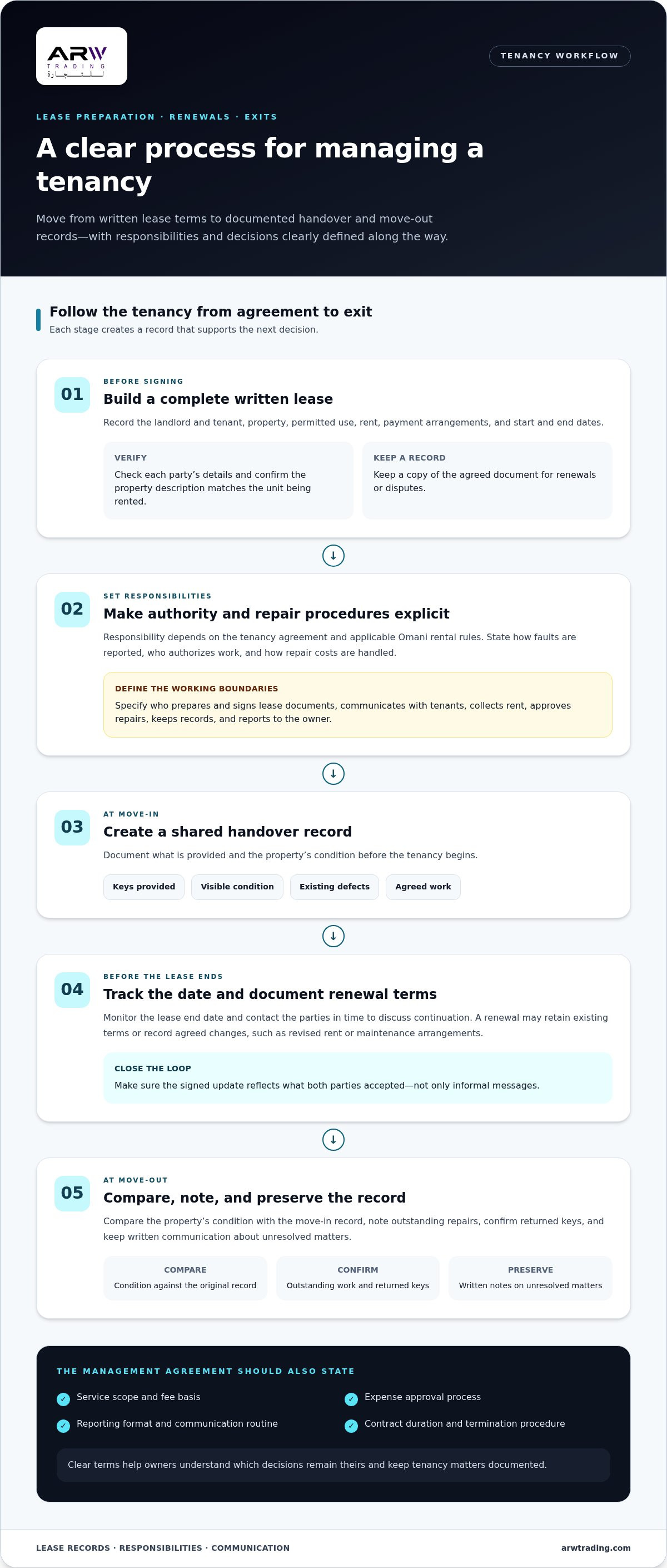
A well-managed tenancy starts with a written lease that identifies the landlord, tenant, property, permitted use, rent, payment arrangements, and start and end dates. Before signing, verify each party’s details and confirm that the property description matches the unit being rented. A manager can coordinate the document, record agreed terms, and keep a copy for renewals or disputes.
Who is responsible for repairs and maintenance under Omani rental rules? Responsibility depends on the tenancy agreement and applicable Omani rental rules. The lease should state how the tenant reports a fault, who authorizes work, and how repair costs are handled, distinguishing routine care from larger property issues.
What are the landlord and tenant rights and obligations in Muscat? The tenancy agreement and applicable Omani rental rules establish the parties’ rights and obligations. The document should clearly record rent and payment terms, permitted use, repair reporting, access arrangements, and the process for notices or other tenancy changes.
Renewal management begins before the current agreement ends. The manager should track the lease end date, contact the parties in time to discuss continuation, and document any agreed changes. A renewal might retain existing terms or record a revised rent or maintenance arrangement. The signed update should reflect what both parties accepted, rather than relying on informal messages.
For a property management contract, specify the manager’s authority and working boundaries. Include who prepares and signs lease documents, communicates with tenants, collects rent, approves repairs, maintains records, and reports to the owner. Set out the service scope, fee basis, expense approval process, reporting format, contract duration, and termination procedure. Clear terms help overseas owners see which decisions remain theirs.
Before a tenant moves in, use a documented handover process. Record the keys provided, visible condition, existing defects, and any agreed work. At move-out, compare the property’s condition with the original record, note outstanding repairs, confirm the keys have been returned, and preserve written communication about unresolved matters. A dated inspection record gives both parties a shared reference.
Use this checklist when choosing a property manager in Muscat:
- Confirm the lease names the correct parties, unit, dates, and terms.
- Record repair reporting, approval, and responsibility procedures.
- Set renewal reminders and document every agreed amendment.
- Use condition records at move-in and move-out.
- Define authority, reporting, expenses, and termination in the management contract.
These steps support reliable income administration and help owners assess real estate opportunities without overlooking the work involved in purchasing and leasing. A clear process makes each tenancy decision easier to review.
Local market experience
A manager with local market knowledge can connect tenant demand to property type, condition, and location. Demand for apartments in Al Mouj may differ from demand for villas in Qurum. Ask how local evidence informs rent recommendations, tenant targeting, and decisions about facilities. Useful advice explains the reasoning behind a valuation instead of presenting a figure without context.
Local conditions can shift over time. Apartment rents in Qurum increased by 16% during Q2 2026, while rental performance still varies by building, condition, size, and location. A market-aware manager considers those distinctions before recommending a rent or leasing approach. For example, a well-maintained unit and a similar unit needing work may attract different tenant interest, even within the same district.
Ask for a clear explanation of the evidence behind rental recommendations. A manager might compare the property’s layout, facilities, condition, and location with similar properties in the area. They should also consider the likely tenant profile and practical demand for that property type. Advice for a family villa may differ from guidance for a compact apartment suited to single occupants.
Market experience should inform operating decisions as well as rent setting. If a building’s facilities need attention, the manager should explain how the issue could affect tenant interest and ongoing maintenance. Ask how local conditions have shaped recommendations, such as changing a listing strategy when a property’s features differ from nearby alternatives.
Use these steps to assess the quality of local market advice:
- Ask which Muscat locations and property types the manager evaluates.
- Request the factors behind a rent recommendation, including condition and facilities.
- Discuss how tenant demand differs for apartments and villas.
- Clarify how market changes influence leasing decisions and property upkeep.
- Ask how the manager will report changes that may affect your investment.
When purchasing or holding a rental property, consider more than potential income. Review the tenant profile, practical demand, operating costs, and management requirements together. A valuation should reflect the specific unit and its condition, not just a district label. For example, a villa’s layout and upkeep may affect its appeal differently from an apartment nearby.
Ask for market advice that separates observed conditions from recommendations. A useful discussion identifies the relevant location, property type, tenant needs, and facilities, then explains how those factors support a decision. This gives owners a clearer basis for comparing opportunities and setting priorities. In Muscat, local knowledge is most useful when it leads to property-specific actions, not broad assumptions about the market.
Average rents for four-bedroom villas in Al Mouj, Muscat, reached OMR 1,700 in Q2 2026. Choose a company whose consultants base advice on market studies and data analysis.
Rent collection and insurance
Rent collection should follow the payment terms in the signed lease. The manager records each amount due, payment received, date, and outstanding balance against the correct apartment or villa. A clear ledger helps the owner distinguish rent from deposits, utility reimbursements, or approved property expenses. For example, a monthly statement can show the opening balance, rent received, deductions, and closing balance.
Agree on the collection process before management begins. Document where tenants pay, how receipts are issued, when funds are reported to the owner, and how missed payments are communicated. If rent arrives late, the manager should record the date, notify the relevant parties under the agreed procedure, and retain the correspondence. This creates a traceable record rather than relying on verbal updates.
Owners should also understand how the manager handles payment discrepancies. Ask how they flag a short payment, an unexplained transfer, or an unpaid balance. Clarify who follows up with the tenant and which decisions require the owner’s approval. A defined process avoids confusion when an owner is overseas or managing more than one property investment.
Insurance needs separate review. The property owner should understand which property and liability risks their policy addresses, what exclusions or conditions apply, and how to report claims. A manager can support administration by documenting a reported incident, arranging access for an inspection, and sharing relevant records when authorized. Coverage is determined by the policy, not the rent collection process.
For example, if a tenant reports water damage in an apartment, the manager can record the report, document the visible condition, and notify the owner promptly. The owner can then follow the insurer’s reporting process and provide requested policy information. Keep incident notes, photographs, repair records, and insurer communications together so the sequence is easy to review.
Before signing a management agreement, clarify whether insurance-related administration is included in its scope. Specify who reports incidents, arranges access, communicates with the insurer, and approves repair work. Identify any owner decisions that must be obtained before action. These boundaries are especially useful when an overseas landlord cannot attend the property in person.
- Confirm the rent schedule and payment channel stated in the lease.
- Request a statement that separates rent, deductions, and balances.
- Define how late or partial payments are documented and escalated.
- Review the insurance policy directly and record its claims process.
- Set out the manager’s incident reporting and approval responsibilities.
When reviewing a real estate investment, compare expected rental income with operating responsibilities, including recordkeeping and insurance administration. A suitable management arrangement makes each task visible: payment monitoring, owner reporting, incident documentation, and approvals. These procedures help an owner assess whether a residential property can be managed consistently from abroad, without confusing administrative support with insurance coverage.
Buy-to-let management for overseas landlords
Overseas owners need a defined local process for decisions, access, records, and rental operations. Clarify who can approve tenant selection, maintenance, and spending. The manager should report each decision through an agreed channel and retain supporting documents. For international owners, clear responsibilities help prevent delays when travel or time differences limit direct involvement.
Before purchasing, verify ownership eligibility for the specific property or development in Oman. Foreign freehold ownership is subject to specific rules and limited to designated areas. Eligibility and transaction conditions can differ between projects and properties. Review the ownership structure, building condition, parking availability, and ongoing maintenance costs before committing.
Buy-to-let analysis should connect purchase assumptions with realistic rental conditions. Calculate rental yield by expressing annual rent as a percentage of the purchase price. Assess net income after expenses. Include operating costs and management requirements, then compare the result with your intended holding period and use.
For example, an apartment may appear suitable for rental because its location attracts tenant interest. Its actual performance still depends on condition, building facilities, parking, and maintenance needs. A villa may require a different operating plan. A manager’s local assessment should identify the relevant tenant profile and practical demand, rather than assuming all Muscat properties perform alike.
Set up an overseas management arrangement with clear reporting and decision controls. Agree how the owner receives rental statements, expense records, inspection updates, and requests for approval. Identify which routine actions the manager can handle and which decisions require the owner’s instruction. A shared record of approvals helps the owner review activity without relying on informal conversations.
- Verify ownership eligibility and transaction conditions for the specific property.
- Review building condition, parking, facilities, and ongoing maintenance requirements.
- Assess tenant profile, practical rental demand, and management needs.
- Calculate rental yield from annual rent and purchase price, then assess net income after expenses.
- Agree on reporting channels, approval limits, and records for overseas access.
Off-plan developments need their own assessment. Review developer documentation, contract terms, the construction timeline, and whether the delivery schedule suits the intended rental use. A staged payment structure does not replace an assessment of leasing plans or future operating needs. For an overseas buyer, these details connect purchasing decisions with the work required after handover.
Treat expected returns as an assessment, not a promise. Compare the property’s purchase assumptions with rent, expenses, condition, and management responsibilities. A local manager can coordinate the ongoing rental process, while the owner retains oversight of investment decisions. This division supports documented, practical management from outside Oman.
Credibility and transparency
Assess credibility through verifiable records, clear service boundaries, and explanations of costs. In Muscat, compare how each manager documents ownership details, property procedures, and market assumptions.
Company Ratings
What are the best-rated property management companies in Muscat, Oman? A single rating cannot establish which company suits every landlord, because platforms, review samples, and service scopes differ. Compare recent, specific feedback about communication, accounting, maintenance coordination, and issue resolution. Look for consistent patterns across reviews, not an isolated comment or unsupported ranking.
Then assess whether the company explains its process clearly. For example, ask how it records tenant concerns and reports property activity. Clear explanations of ownership information, legal procedures, and pricing help you judge credibility alongside public feedback. A company’s name matters less than evidence that its stated practices match the work your property requires.
Fees and Hidden Costs
What fees, hidden costs, and risks should landlords compare when choosing a Muscat property manager? Compare the fee basis, included tasks, additional charges, and conditions that trigger extra work. A low headline fee may exclude tenant changes, inspections, maintenance coordination, or renewal administration. Ask for the scope and exclusions in writing, then compare like-for-like proposals.
Build a budget around the property’s actual operating needs. For example, a villa with extensive facilities may require different coordination from a furnished apartment. Clarify who approves expenses, how invoices are supported, and whether the manager adds charges to third-party work. Fees vary by property and scope, so request a quote.
Risks and Transparency
Transparency reduces uncertainty around authority, ownership records, and financial decisions. Confirm who can instruct work, communicate with tenants, and access property documents. A management agreement should explain reporting frequency, record access, expense approvals, and termination steps. These terms matter when the owner lives overseas or shares ownership with someone else.
Review market claims against their stated basis. If a manager discusses rental trends or projected income, ask which property features and operating assumptions support the estimate. Separate observed conditions from forecasts, then record the assumptions used. This helps prevent an optimistic projection from shaping a budget without accounting for maintenance, vacancies, or management requirements.
- Compare recent reviews for repeated, relevant service details.
- Request written scope, exclusions, and expense approval procedures.
- Confirm ownership records, reporting access, and decision authority.
- Record assumptions behind any rental or income estimate.
For a structured discussion of property management in Muscat, review property management options and compare the responsibilities against your property’s needs.
Reputation is only one part of assessing credibility. Check a real estate company’s standing alongside the clarity of its information about property ownership, legal procedures, and prices. These points offer a practical basis for judging whether its explanations support an informed assessment.
ARW Trading: Property Management for Owners & Landlords in Muscat (property management company in Muscat and Oman)
ARW Trading, Muscat, Oman, provides property management for owners and landlords in Muscat and Oman. This is a practical next step for owners seeking local coordination for their rental property, including landlords living overseas who need management support in Muscat.
ARW Trading also provides project marketing for off-plan developments, owners association management, and digital board elections for owners associations. These services may suit developers and property communities with distinct management needs, while landlords can focus first on the scope required for their individual property.
Before proceeding, outline the property’s needs and the responsibilities you expect a manager to handle. Then compare that scope with the relevant service. To discuss property management for your Muscat property, visit arwtrading.com.
Set a Clear Management Plan for Your Property
Your next step is to turn your priorities into a written scope of work. Identify which decisions you want handled locally, what updates you expect, and which responsibilities you intend to retain. This gives you a practical basis for choosing a property manager in Muscat and assessing whether the working arrangement suits your ownership plans.
Prepare a short brief covering your property, priorities, and preferred communication process. Use it to discuss the scope of support and the responsibilities that matter most to you.
To discuss your requirements with ARW Trading, call +968 7927 4373 or +968 7927 4245. A clear brief can help make the next conversation focused and useful.
Frequently Asked Questions
What services should a property manager in Muscat provide?
A property manager’s scope should match the property and your delegation needs. For a rental home, responsibilities may include tenant placement, rent administration, tenancy coordination, and maintenance follow-up. Ask whether the agreement covers vacant periods or only active tenancies. Separate ongoing management from brokerage or owners association work, then record the selected tasks in the agreement.
How can I verify a property manager's license and reputation in Oman?
Request the manager’s applicable licensing or authorization details, then verify them with the relevant issuing authority in Oman. Confirm that the name matches the management agreement and payment records. To assess reputation, compare detailed feedback from more than one source, focusing on service delivery. Ask for relevant owner references and compare their experience with the responsibilities you require.
How do Muscat property managers handle tenant screening and rent collection?
Managers can gather rental applications, review supporting information, and apply selection criteria agreed with the owner. Ask how they document decisions and inform applicants. For rent collection, clarify how payments are matched to each tenancy and how receipts are issued. Requiring a property or tenancy reference with each transfer, for example, can reduce ambiguity in account records.
How do property managers handle vacant properties and tenant turnover in Muscat?
During a vacancy, a manager can coordinate property access, review readiness, and arrange approved work before marketing resumes. At turnover, clarify who handles viewing requests, keys, and condition records. If a damaged appliance affects viewings, for example, the manager can report it, obtain the owner’s decision, and coordinate repairs before arranging further appointments.
What questions should I ask before hiring a property manager in Muscat?
Ask who your main contact will be, how updates are delivered, and which records you can access. Clarify delegated authority, owner approvals, tenant complaint handling, and how instructions are recorded. Request a sample report or agreement to understand the format. Then discuss a scenario, such as a tenant reporting a fault while you are abroad, and map each step.
About the author
Raheem Wyne. Raheem Wyne works at ARW Trading, a real estate and property management company in Muscat, Oman. He works with owners' associations, landlords, developers and property investors on owners association management, property and facilities management, brokerage, off-plan sales and marketing, and digital board elections. His articles share practical guidance for property owners and investors in Oman. Raheem Wyne on LinkedIn