
Tenant Screening and Rent Collection in Muscat: How Property Managers Protect Your Income
· 17 min read · By Raheem Wyne

For tenant finding and rent collection, the landlord or an authorised representative normally submits the lease registration application through the applicable municipal process. Registration creates an official tenancy record.
Clear payment terms, organised records, and timely follow-up help owners manage rental income. This article explains who registers the lease, how to handle payments and charges, and what to track during a tenancy, including tenant details and renewal information.
Written by Raheem Wyne on behalf of ARW Trading. Last reviewed: 20 October 2026.
Key Takeaways
- Use the lease’s payment terms to guide rent reminders and overdue-payment follow-up, and keep a clear record of communications.
- Record the security deposit, agreed charges and property condition so financial responsibilities are easier to track during the tenancy.
- Keep tenant details, lease dates, payment history and renewal notices organised in one reliable record.
- Understand how advance rent and post-dated cheques affect payment timing, and monitor each due date against the lease.
- Clarify which tenant-finding and management tasks are included in the agreed service scope before appointing a property manager.
Rent reminders and overdue-payment follow-up
Rent follow-up means tracking each due date, recording payments, and responding to arrears in line with the lease. In Oman, consistent records help owners distinguish a late payment from a wider tenancy dispute.
Rent Reminder Follow-Up
A rent reminder is a dated notice that restates the amount due and the lease’s payment deadline. It gives the tenant a clear opportunity to resolve a missed payment and records the landlord’s communication. Before escalating, review the agreed terms and retain copies of reminders, replies, and payment evidence.
Agent or direct management? Direct management gives the landlord control over reminders and tenant contact, but requires personal tracking and follow-up. An agent can handle routine communication and maintain records, while the owner retains decisions that require their authority.
What are the landlord’s legal duties? The landlord or authorised representative should follow the lease’s payment terms and contractual process when rent is delayed. The landlord or authorised representative normally submits the lease-registration application; according to Gov.om, the registration fee is 3% of the monthly rental value.
Payment Risks and Cheques
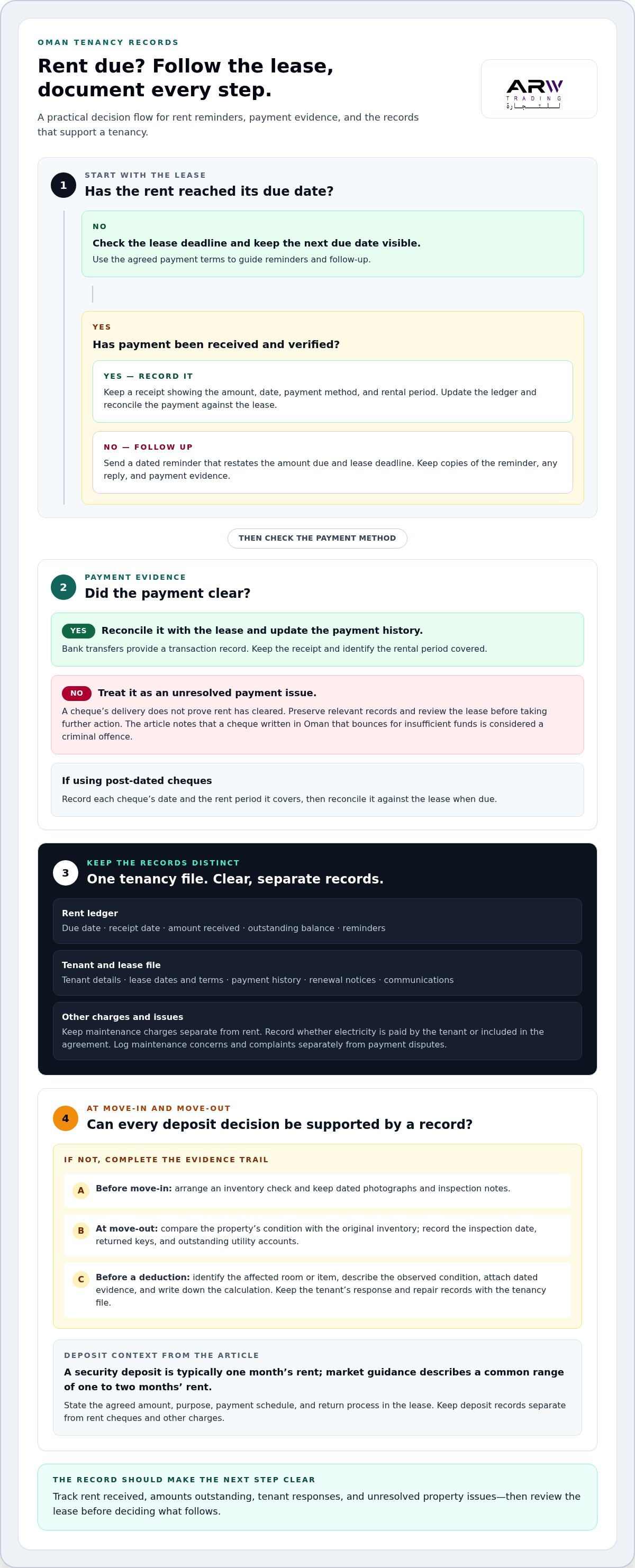
Payment risk includes missed transfers, unclear payment references, and cheques that cannot be honoured. Tenants are advised to use bank transfers because transaction records create a paper trail. Post-dated cheques are also common in Oman, so record each cheque’s date and the rent period it covers, then reconcile it against the lease.
A cheque written in Oman that bounces because of insufficient funds is considered a criminal offence. Treat a failed cheque as a serious payment issue, preserve the relevant records, and review the lease before taking further action. A cheque’s delivery does not prove that rent has cleared.
For each payment, issue or retain a receipt showing the amount, date, payment method, and rental period. A simple ledger can track the due date, receipt date, outstanding balance, and reminders. Keep maintenance charges separate from rent, and record whether electricity is paid by the tenant or included in the agreement.
How are arrears, maintenance, and complaints handled? The manager reviews the lease, records arrears, contacts the tenant, and logs maintenance concerns or complaints separately. Oman’s Ministry of Interior reported that the electronic Insaf system can handle applications and complaints about delayed rent, eviction, maintenance, and rental-contract breaches.
Owner reports should show rent received, amounts outstanding, tenant responses, and unresolved property issues. This information supports decisions about the next contractual step and helps separate payment disputes from maintenance complaints.
Typical security deposits and housing charges
A security deposit helps cover obligations left unresolved at the end of a residential tenancy. In Oman, record its amount, purpose, and return process in the lease, and retain the supporting documents.
Deposit Return at Move-Out
A deposit return accounts for the tenant’s funds when the rental ends. Clear records help both parties distinguish refundable funds from documented costs. Arrange an independent inventory check before move-in, then compare the property’s condition at move-out with that record. Keep dated photographs, inspection notes, and the lease together.
At handover, list the returned keys, inspection date, and any outstanding utility account. For example, compare the move-out inspection note with the original inventory before deciding whether a charge relates to a pre-existing condition. Keep the tenant’s written response in the same file.
Damage Deductions from Deposits
A damage deduction is an amount retained for a documented property issue, not ordinary rent or an unrelated charge. A move-in inventory gives the landlord and tenant a comparison point, such as a recorded mark in a bedroom or damage to an appliance. Before settling the remaining deposit, document each issue, its evidence, and the calculation in writing.
Use itemised notes rather than a general description such as “repairs required.” Identify the affected room, describe the observed condition, and attach dated photographs from both inspections. Keep repair records with the tenancy documents so the basis for each proposed deduction is traceable.
Deposits, Fees, and Rent Cheques
Deposits, tenancy-related charges, and rent cheques serve different purposes and need separate records. In Oman, a security deposit is typically one month’s rent; market guidance describes a common range of one to two months’ rent. State the agreed deposit and payment schedule separately in the lease, rather than treating a rent cheque as evidence of a deposit.
Oman has no statutory maximum for rental security deposits, according to the stated market guidance. Written terms should identify the amount received, what it secures, and how proposed deductions will be assessed. Keep the payment receipt with the signed agreement and tenant documents.
The municipal tax on property rents in Oman is 3%. Record its treatment separately from rent and agreed service charges. The lease should also specify who pays electricity and water accounts, and how final bills are handled at move-out.
At handover, retain the signed inventory, key record, final utility statements, rent receipts, and any written damage assessment. Compare these documents with the move-in file before calculating the balance. A dated inspection record helps both parties review the settlement against the property’s documented condition.
Tenant and lease information management
For each tenancy in Oman, keep tenant details, agreement terms, and supporting documents in one organised property file. Update it whenever the agreement or contact information changes.
Landlords can assess prospective tenants by comparing application details with identity documents, rental history, and proposed payment arrangements. Record the documents reviewed and agreed conditions before deciding.
Tenant and Lease Records
Tenant and lease records bring together the signed agreement and relevant tenancy documents. Owners need a reliable reference throughout the rental period, so record tenant contact details, the property, rent, contract duration, payment method, and rental purpose. For multiple apartments, identify each unit clearly to avoid mixing files and correspondence.
Keep the written lease, registration record, handover documents, and amendments together. Oman’s landlord-tenant framework includes Royal Decree 6/89 and subsequent amendments. Lease agreements can be registered through government channels, including the Baladiyati app or an authorised Sanad centre. Compare the application details with the signed agreement before submission.
Prospective Tenant Verification
Tenant verification means comparing an applicant’s stated details with supporting documents before accepting a tenancy. A consistent record helps owners make a documented decision rather than rely on informal assurances. Compare names and contact information across the application and identification documents, then record any missing or inconsistent details for resolution.
Review the proposed lease period, intended occupants, payment method, and ability to meet the agreed schedule. If the applicant provides rental references, note their source and relevance. Apply the same criteria to each application, and distinguish proposed payments from funds actually received.
Tenant-Finding Service Inclusions
A tenant-finding assignment covers the agreed work between marketing a rental and preparing it for occupancy. Its value depends on a written scope: identify whether it includes enquiries, viewings, application handling, document review, lease coordination, and handover records. Define responsibilities so owners know which tasks are included and which remain theirs.
Fees vary by property and scope, so request a quote. The management agreement should identify responsibilities, reporting arrangements, and work charged separately. For a rental apartment, clarify who records applicant documents, coordinates the written lease, and tracks payment arrangements after signing. This defines the handover from tenant selection to ongoing administration.
Use a tenancy calendar to record the agreement’s end date and notice deadline. Rental contracts commonly renew unless notice is given, typically three months before expiry. Retain any notice and update tenant records when the agreement is renewed or amended.
Advance rent and post-dated cheques
In Muscat, tenants commonly provide advance rent through post-dated cheques covering future periods. Record the agreed schedule in the lease, then track it against each rent period.
Agreeing the Advance-Rent Schedule
Oman landlords routinely request advance rent for three, six, or twelve months, often using post-dated cheques. Before occupancy, state the covered period, payment dates, and method in the written lease. This gives both parties a shared reference for when each payment is due and which rental months it covers.
Article 6 of Oman’s Tenancy Law allows rental agreements for a mutually agreed period, including yearly, half-yearly, or quarterly terms. Most Muscat rental properties are let for one year. For example, a lease with quarterly rent payments should distinguish the contract duration from the separate payment intervals.
Tracking Post-Dated Cheques
A post-dated cheque represents a scheduled payment, not a substitute for a rent ledger. Record the cheque date, rent period covered, receipt status, and eventual clearance. For a six-month advance schedule, the file should show which months each cheque covers and when the next payment is due.
Reconcile the schedule with the lease whenever it is renewed or amended by agreement. If the tenant and landlord change the payment timing, document the change in writing and retain it with the original agreement. This prevents a cheque date from being mistaken for a revised rent due date.
Lease Terms and Registration Records
Oman’s landlord-tenant framework includes Royal Decree 6/89 and subsequent amendments. The lease should identify the agreed rent, duration, payment method, and rental purpose. Keep the registration record with the signed agreement, so the official tenancy details and private payment schedule remain easy to compare.
During the lease term, agreed rent cannot be increased unless both parties agree. If they change the amount or payment schedule, preserve the written agreement and update the rent record before issuing or accepting replacement cheques. This keeps the owner’s account aligned with the terms both parties accepted.
For furnished rentals, record the furnishing status and inventory separately from rent instalments. A clear file links the property condition, lease period, and advance-payment schedule without treating furniture or utilities as rent. Review upcoming cheque dates against the tenancy calendar before each payment period begins.
What tenant-finding services are included in Muscat property management fees?
Tenant-finding scope varies by property and agreement, so the management contract should identify each included task. Fees vary by property and scope, so request a quote. In Muscat, distinguish finding a tenant from ongoing rent collection, lease administration, and property oversight.
Marketing and Enquiry Handling
A tenant-finding assignment may cover preparing a listing, responding to enquiries, and coordinating property viewings. The agreement should state which steps the manager handles and which decisions remain with the owner. For example, clarify who approves the advertised rent, confirms viewing times, and reports interest from prospective tenants.
Agree how the property will be presented, including its location, furnishing, condition, and occupancy terms. A viewing record can note the date, applicant’s contact details, and follow-up status. This gives the owner a traceable account of enquiries without implying that every management fee includes the same marketing channels.
Application Review and Lease Coordination
Application handling can include collecting applicant details and supporting documents for the owner’s review. Define the process in writing: who receives documents, what information is recorded, and how the owner makes the final decision. Clarify whether the manager coordinates lease preparation or only forwards the parties’ agreed terms.
Before signing, confirm the proposed lease duration, rent, payment schedule, deposit terms, and responsibility for utilities. Keep the signed agreement and tenant file together. If municipal registration support is part of the arrangement, state who submits the application and who retains the registration record.
Handover and Ongoing Management
Tenant placement may end at signing or continue through move-in coordination. Specify whether the agreed work includes a condition inventory, key handover, and recording the tenant’s move-in date. A dated handover record connects tenant finding with later questions about property condition and tenancy responsibilities.
Rent collection is a separate scope item unless the management agreement combines it with placement. Clarify who tracks due dates, records payments, issues receipts, follows up on arrears, and reports balances to the owner. If post-dated cheques are used, identify who logs cheque dates and checks each payment against the lease schedule.
Compare proposals using the same task list rather than relying on a single fee label. Ask for included deliverables, exclusions, reporting format, and any charges outside the agreed scope. For example, distinguish routine tenant enquiries from maintenance coordination after occupancy, as they involve different work and records.
A written scope makes the decision clearer: it shows what happens before signing, at handover, and during the tenancy. To discuss a property management arrangement for a Muscat rental, call +968 7927 4373 or +968 7927 4245.
ARW Trading: Property Management for Owners & Landlords in Muscat (property management company in Muscat and Oman)
ARW Trading provides property management for owners and landlords across Oman. Owners can consider this support when tenant coordination, lease administration, and income records need consistent oversight.
A structured management arrangement can bring tenant-related responsibilities into one accountable process. Before appointing a manager, define the required scope, including tenant finding, rent follow-up, lease documentation, and owner reporting. Clear responsibilities show which tasks are handled and which decisions remain with the owner.
ARW Trading also provides project marketing for off-plan developments and owners association management across Oman, including digital board elections. For an individual rental property, its property management service is the relevant option.
To discuss managing your Muscat rental property, contact ARW Trading at +968 7927 4373.
Set a Clear Management Framework for Your Next Tenancy
A tenancy runs more smoothly when responsibilities are agreed before the next renter moves in. Decide who handles applicant communication, lease administration, payment monitoring, and owner updates. A written scope clarifies where each task begins and ends, giving you a practical basis for reviewing the arrangement over time.
For owners weighing tenant finding and rent collection in Muscat, the next step is to match the management structure to the level of involvement they want. Some prefer to remain directly involved in tenant decisions; others want routine administration coordinated on their behalf. The right scope makes that division clear without obscuring the owner’s oversight.
ARW Trading provides property management for owners and landlords across Oman. Its other relevant work includes project marketing for developers and owners association management, including digital board elections. Discuss your property management requirements and the responsibilities you want covered.
Contact ARW Trading about property management to discuss the next step for your rental property.
Frequently Asked Questions
Do I need to register my lease, and who handles this?
Registering a lease creates an official tenancy record, and the landlord or an authorised representative normally submits the application. Residential leases in Muscat can be registered through the government portal, the Baladiyati app, or an authorised Sanad centre. Before submission, compare the application with the signed agreement to ensure the tenant, property, rental period, and agreed rent are consistent.
What Happens When Rent Is Delayed?
Compare the missed payment with the lease’s due date and payment terms, then contact the tenant and record the response. For example, note the date of a reminder and whether the tenant gives a payment date or raises a maintenance issue. Document these matters separately, as a payment dispute and a repair complaint may need different follow-up.
What Is Rent Collection Support?
Rent collection support covers the administration of scheduled tenant payments and related records. It can include monitoring due dates, recording receipts, reconciling payment references, and preparing owner updates. For example, an owner’s statement can distinguish rent received from an instalment still outstanding. The written management scope should clarify who performs each task and how payment information is reported.
What are the main property rental websites in Oman?
Facebook Marketplace is one channel used for Muscat rental listings. A sample of listings posted there between 10 and 16 September 2026 covered different property types and areas. Owners can make listings easier to assess by presenting accurate rent, location, furnishing, availability, and viewing details. Keep enquiry records so each prospective tenant receives consistent information about the property.
Which Muscat real estate agencies offer tenant finding and rent collection services?
ARW Trading provides property management for owners and landlords, including finding tenants and collecting rent. The management agreement should define the specific scope, such as enquiry handling, tenant coordination, payment follow-up, and owner reporting. This clarifies which responsibilities are delegated and which decisions, including approval of tenancy terms, remain under the owner’s control.
How much do Muscat property managers charge for tenant placement and rent collection?
Management fees vary by property and scope, so request a quote based on the work required. Tenant placement and ongoing rent collection may involve separate tasks, such as marketing, application coordination, payment monitoring, and owner reporting. Ask for the proposed responsibilities and any separately charged work in writing. This makes it easier to compare services by scope rather than fee label alone.
How does rent collection work for residential properties in Muscat?
The tenant pays according to the lease schedule, and the landlord or manager records each payment against its covered period. Bank transfers provide a transaction record, while post-dated cheques need to be tracked by date and rental period. A receipt or account statement shows what has cleared, what remains due, and whether any payment needs follow-up.
How are tenancy agreements registered in Muscat, and what documents are required?
The landlord or an authorised representative normally submits the registration application through the government portal, Baladiyati app, or an authorised Sanad centre. Keep the signed tenancy agreement available, with tenant and property details matching the application. The record should reflect the agreed rent, tenancy period, payment terms, and rental purpose. Review the entries before submission to reduce errors in the registered information.
About the author
Raheem Wyne. Raheem Wyne works at ARW Trading, a real estate and property management company in Muscat, Oman. He works with owners' associations, landlords, developers and property investors on owners association management, property and facilities management, brokerage, off-plan sales and marketing, and digital board elections. His articles share practical guidance for property owners and investors in Oman. Raheem Wyne on LinkedIn