
Owners Association Election Audit Trail: Oman Guide
· 17 min read · By Raheem Wyne

If an owner questions an election result months later, can the association explain how the vote was conducted without exposing individual ballots? A clear owners association election audit trail links each stage of the process to evidence, while keeping ballot privacy separate from the records needed to review the outcome.
Transparency and confidentiality can work together. Records should make it possible to follow eligibility checks, voting administration, the count and reporting without unnecessarily revealing how any individual voted. In Oman, an organised trail helps an association explain its decisions and review the process using contemporaneous records instead of trying to reconstruct events later.
This guide explains what to document, how to organise records for review, and how to keep election evidence separate from ballot choices. It also covers how managed digital elections can support accountable governance. ARW Trading provides digital board elections that verify eligible owners and units, maintain an audit trail and provide a certified election report.
Key Takeaways
- Map the election from authorisation to final reporting. At each stage, record the action, responsible role, date or time, and supporting evidence.
- A useful owners association election audit trail is more than a collection of files. Consistent names, version control, cross-references and an index make records easier to review.
- Keep process evidence distinct from individual ballot choices so the association can explain how it reached the result while respecting ballot privacy.
- Use a repeatable review sequence to check scope, completeness, consistency, exceptions and whether the final report aligns with the approved terms and count.
- Managed digital election administration can organise evidence across eligibility checks, voting and reporting. ARW Trading provides digital board elections with a certified election report.
Why an Owners Association Election Audit Trail Matters in Oman
An election result tells owners the outcome. It does not, by itself, show how the association reached it. An owners association election audit trail is an organised record of the actions and evidence behind an election, from setup through the final report. It connects decisions, such as confirming eligibility or closing the count, to records showing what happened and when.
This is useful in owners association governance in Oman because boards need to explain decisions clearly and consistently, rather than rely on recollection. The purpose is not to create paperwork for its own sake. It is to make the process understandable if an owner asks how eligibility was assessed, how participation was recorded or how the announced result was derived.
A useful distinction is: An election audit trail documents the process behind a result; a results announcement states the outcome. A folder of unrelated files may contain relevant documents, but without dates, context or links between them, a reviewer may struggle to see how they fit together. The general concept of recording actions and evidence over time is also described in What is an Audit Trail?
What an election audit trail can and cannot establish
Records can show what was documented, who recorded or approved an action, and when it occurred. For example, an eligibility record can help explain why a unit was included in the voting list, while a count record can show how the final total was compiled. Together, these materials provide procedural traceability.
Records do not automatically prove that every step met every applicable legal requirement or determine whether an election is legally valid. Those are separate questions that may depend on the governing documents and relevant rules. A certified election report can summarise the outcome, but it does not replace the supporting records that make the process reviewable. The report and the underlying evidence serve related but distinct purposes.
Why owners associations need a reviewable election record
Owners may reasonably want an explanation of how the voter list was prepared, how participation was tracked and how the result corresponds with the count. A consistent record lets the board respond by following documented steps instead of piecing events together from messages, meeting notes or individual memories. It can also help distinguish a genuine discrepancy from a missing or unclear document.
Continuity matters, too. Board members and administrators can change between elections. A dated, organised record gives the next responsible person context: what decisions were made, which version of a record was final and where the supporting evidence is kept. Without that structure, the association may retain files but lose the connections that explain them.
Start by preserving records so their purpose and sequence are clear, while limiting unnecessary exposure of individual ballot choices. The goal is to make administration accountable without treating ballot details as general-purpose documentation. That balance supports a considered review and a clear explanation of the result.
How to Build the Oman Owners Association Election Record Across Its Lifecycle
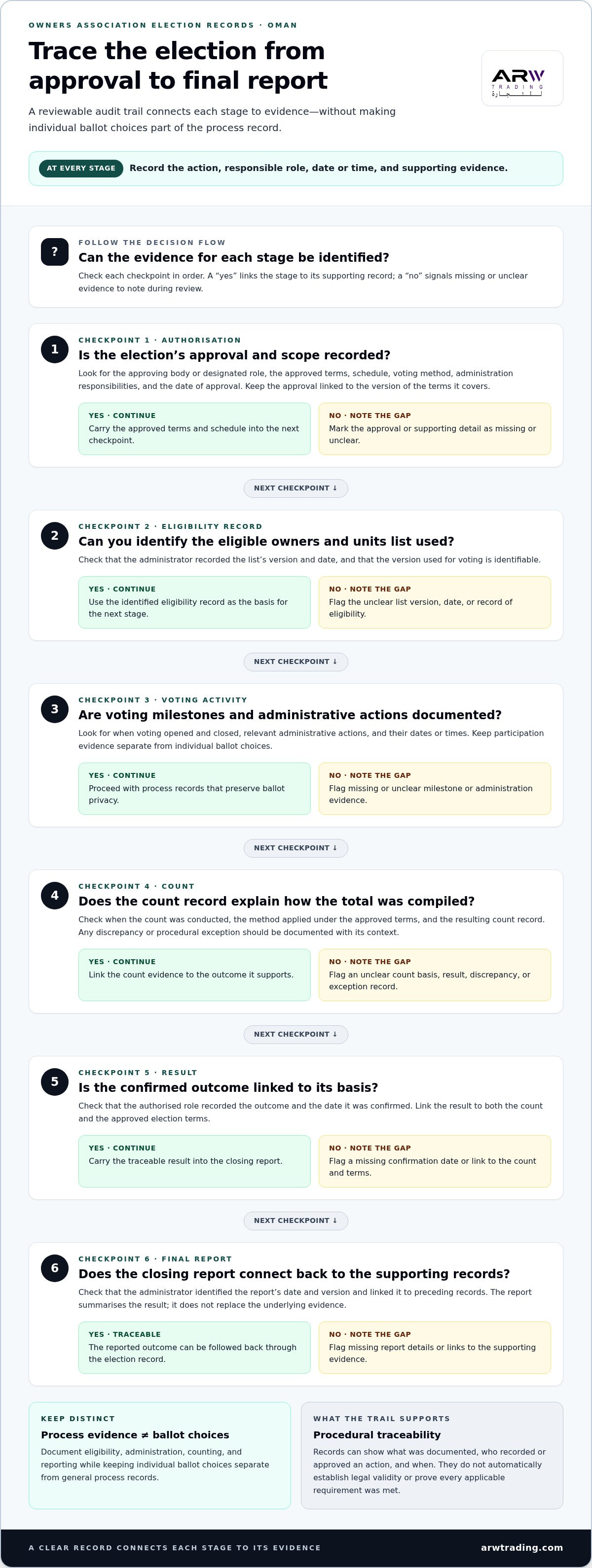
A reviewable record follows the election in sequence. At each stage, note the action, the person or role responsible, the date or time, and the record created. This turns separate documents into a traceable timeline. A reviewer can connect an approved decision to the next administrative step and, ultimately, to the reported result.
Use the following lifecycle as a practical framework for an owners association election audit trail. Assign roles according to the association’s arrangements, and link each entry to its supporting document.
- Authorisation: The approving body or designated association role records the decision to hold the election, the approved terms, schedule, voting method and administration responsibilities. Keep the approval with the version of the terms it covers and its date.
- Eligibility record: The designated administrator records the version and date of the eligible owners and units list used for the election. Treat eligibility verification as a documented checkpoint, and keep the list used for voting identifiable.
- Voting activity: The election administrator records key milestones, such as when voting opens and closes, along with relevant administrative actions and their dates or times. Keep participation evidence separate from individual ballot choices.
- Count: The person or role responsible for the count records when it was conducted, the method applied under the approved terms and the resulting count record. Document any discrepancy or procedural exception with its context.
- Result: The authorised role records the outcome and the date it was confirmed. Link it to the count and approved election terms so the result can be traced to its basis.
- Final report: The administrator prepares the closing report, identifies its date and version, and links it to the preceding records. The report should summarise the result without replacing the underlying evidence.
What to document before voting opens
Before voting begins, assemble the authorised terms, schedule, voting method and administration roles in one accessible record set. Preserve notices sent to owners and log any change to the schedule or procedure. Each change record should show who approved it, when it took effect and which version it replaced. Record the eligible owners and units list by issue date or version instead of silently replacing an earlier copy. These links show which instructions and records governed the election.
What to document during voting and when results are finalised
During the voting window, record operational milestones and administrative actions, not personal ballot choices in a general review file. At close, link the participation record to the count record, then link the count to the confirmed result and final report. Compare the count and outcome with the approved terms. Describe and document any exception rather than leaving a gap in the sequence.
A timeline links each election action to the dated record that supports it. Keep records in line with applicable rules and the association’s governing documents. Retention periods and process requirements should be established against those requirements before records are adopted or disposed of. Managed digital administration can organise evidence across these stages. ARW Trading’s digital board election service verifies eligible owners and units, maintains an audit trail and provides a certified election report.
Election Audit Trail or File Collection: How to Make Records Reviewable
A collection of election documents is not automatically an audit trail. Reviewability depends on whether someone who was not involved can follow the sequence, understand why each record exists and connect decisions to supporting evidence. For an owners association election audit trail, organisation matters as much as retaining the documents.
The difference is practical:
| Coherent audit trail | Unstructured file collection |
|---|---|
| Records are grouped by election stage and ordered by date. | Files sit together without a clear sequence. |
| Titles identify the record, date and relevant version. | Names such as “final” or “updated” leave uncertainty about which copy applies. |
| Approvals, notices, counts and reports cross-reference one another. | A reviewer must infer how separate documents relate. |
| Amendments and corrections are documented. | Earlier records may be replaced without explanation. |
How to organise records so another person can follow the sequence
Group materials by stage, such as authorisation, eligibility, voting, count and reporting. Use a consistent file-naming pattern that identifies the election, record type, date and version. For example, give a notice and a later approved amendment distinct titles and dates instead of labelling competing copies “final.”
Create a simple index listing each record, its date, responsible role and related documents. Cross-reference the approved terms to the notices issued under them, then connect the count record to the final report. If a record is corrected, preserve a note of the change, its date and reason. Do not silently overwrite the earlier entry. An explained correction is easier to review than an unexplained gap.
How to balance transparency with privacy and access control
Separate records that explain administration from sensitive information that could identify an individual voter’s choice. Reviewers may need to understand the approved process, participation record, count and result. That does not mean every reviewer needs access to every underlying item. Organise materials so process evidence can be examined without unnecessarily exposing ballot choices.
Set access according to role and the association’s procedures, and follow any applicable requirements in the governing documents and rules. Do not assume that a particular file format or technology guarantees integrity, anonymity or admissibility. Those conclusions depend on the records and circumstances, not simply on how a file is stored.
Make the process reviewable while restricting unnecessary access to sensitive data. Apply this principle by providing enough context to explain each stage, preserving links between documents and limiting access to information that does not need to be broadly available.
How Oman Owners Associations Can Review an Election Audit Trail
A post-election review should be proportionate to the election and consistent enough to repeat. The board can follow a defined sequence to assess whether the records tell a coherent story, identify gaps and document its conclusions. This is an internal governance review of the available evidence, not automatically a legal determination about the election.
A proportionate post-election review sequence
Begin by defining the review’s scope: which election and records are being examined, who is responsible and what question the review is intended to answer. Then follow the record set in a fixed order. This helps reviewers distinguish a missing document from a substantive inconsistency and keeps the review focused on relevant evidence.
- Scope: Identify the election, the approved terms being reviewed and the roles conducting the review.
- Completeness: Check that the expected records are present, including approvals, notices, eligibility records, participation information, count records and the final report.
- Consistency: Compare dates and versions. Confirm that the voting window and administrative actions align with the approved terms, and that the participation record, count and reported result connect without unexplained gaps.
- Exceptions: Log missing items, conflicting dates, corrections or other questions. Assign each follow-up to a responsible role and record the response or action taken.
- Conclusion: Summarise the records reviewed, unresolved matters and the basis for the board’s conclusion. Preserve this review note with the election record.
Responding to owner questions without overstating what records prove
For an owner’s question, identify the specific point raised and answer with the relevant process records. For example, connect the approved terms, count record and final report to address a question about the result. Record the question, evidence reviewed, response and any follow-up. If a document is corrected or supplemented, preserve the original and document the change rather than silently altering the review history.
Share information in a way that explains administration without unnecessarily disclosing sensitive voter information or individual ballot choices. A factual account of what the records show is different from a legal conclusion about whether an election is valid or how a challenge should be resolved. Refer specific statutory interpretations to qualified Oman legal advice, and do not present an internal review as a ruling on those questions.
For an owners association election audit trail, a useful review lets another board member understand both the conclusion and the evidence behind it. Keep the review note, supporting references and follow-up actions together so the reasoning remains clear if board responsibilities change. ARW Trading manages digital board elections in Oman, verifies eligible owners and units, maintains an audit trail and provides a certified election report. Arrange digital board election support to organise election administration from eligibility checks through reporting.
How ARW Trading Supports Digital Owners Association Elections in Oman
Once an association has defined what a reviewable election record should contain, managed administration can help organise the work from eligibility checks through reporting. ARW Trading provides digital board elections for owners associations in Oman. Its service verifies eligible owners and units, maintains an audit trail and provides a certified election report.
This service suits boards that want election administration handled as a connected process rather than treating the voter record, election activity and outcome document as unrelated tasks. The association can plan its requirements in advance and define responsibilities and the records needed to support a later review.
What managed digital election support covers
Eligibility checks cover owners and units, creating a documented checkpoint before voting. Election administration maintains an audit trail through the process, helping connect administration to the reported outcome. The certified election report summarises the result. It is an election document, not legal advice or a determination that every aspect of an election is legally valid.
This distinction matters. An organised process and report can support governance discussions by making the election easier to explain, while questions about statutory interpretation remain separate. Boards should consider their governing documents and applicable requirements when setting the election scope and procedures.
Planning the next owners association board election
Before the process begins, the board can prepare a concise planning brief. This aligns association expectations with administration and reporting needs, and gives the election a clear operational framework.
- Scope: Identify the board election and the approved terms that will guide it.
- Responsibilities: Set out who will approve the terms, coordinate administration and receive the report.
- Dates: Establish the intended schedule and milestones the association needs to plan around.
- Reporting needs: Decide what outcome information the board needs for its records and how it will organise supporting material for review.
These planning points help the association prepare for an orderly digital election process across Oman. They give administrators a shared reference for the election’s scope, sequence and reporting, without assuming that a particular technology or record format alone establishes privacy, integrity or legal compliance.
An owners association election audit trail is most useful when process and outcome records can be understood together. ARW Trading’s managed digital board election service brings eligibility checks, election administration, an audit trail and a certified election report into one service process.
If your board is planning an upcoming election, discuss its administration needs with ARW Trading, including scope, responsibilities, schedule and reporting expectations.
Set a Clear Standard for the Next Election
The next election is an opportunity to make good recordkeeping part of routine association governance. Before the process begins, the board can agree who will oversee administration, how records will be organised and how questions or corrections will be documented. A consistent approach helps future board members understand the record without relying on informal handovers or individual recollection.
A well-managed owners association election audit trail supports accountable decisions and keeps review focused on relevant evidence. For associations planning a board election in Oman, ARW Trading provides digital election administration from eligibility checks through reporting.
Discuss digital board elections for your owners association and plan the administration needs for your next election. A clear plan is a practical step toward confident, accountable governance.
Frequently Asked Questions
What is an owners association election audit trail?
An owners association election audit trail is organised evidence that lets a reviewer follow how an election was administered and how its outcome was reached. It can answer practical questions, such as which approved election terms applied during voting and which record documents that approval. The trail supports explanation and review. Its usefulness depends on clear links between records and the actions they describe.
What records should an owners association keep after an election?
Keep the records needed to explain the election’s authorisation, applicable terms, notices, eligible-owner and unit list, administrative milestones, count, result and final report. Include dates and relevant versions so a later reviewer can distinguish the list used for voting from an earlier draft. If an owner raises a question, preserve the question and the association’s response with the review notes, while limiting access to sensitive information.
Can an online owners association election have an audit trail?
Yes. An online election can have an audit trail if the administration records relevant decisions, dates, participation information, counting and reporting in a reviewable way. Conducting a vote online does not, by itself, show that records exist or are connected. The board should be able to identify which approved terms applied and locate the associated records without relying solely on a result screen.
Does an election audit trail prove that an election was legally valid?
No. An audit trail can show what was recorded and help assess whether the documented process followed the association’s stated terms. It does not automatically establish legal validity or resolve a challenge. If a dispute turns on how Oman law or a governing document applies, keep the factual record separate from legal conclusions and obtain qualified Oman legal advice on the specific interpretation.
How can an association protect voter privacy while keeping an audit trail?
Separate records that explain election administration from information that could reveal an individual’s ballot choice. For instance, a board may review the approved voting period and aggregate count without circulating sensitive voter-level material. Set access according to responsibilities and association procedures, and record who handled restricted information where appropriate. The aim is to provide enough evidence to assess the process without making personal choices broadly accessible.
Who should review an owners association election audit trail?
The association should assign the review to a clearly identified person or group under its governance procedures. Where practicable, choose reviewers who can assess the records impartially and are not relying only on their own recollection of administering the vote. The review record should identify its scope, materials examined, questions raised and conclusion. Any further escalation should follow the association’s procedures and the nature of the issue.
How long should owners association election records be retained in Oman?
The appropriate retention period may depend on applicable Oman requirements and the association’s governing documents. Before adopting a schedule, identify which records it covers, who is responsible for retaining them and how sensitive material will be handled. Verify specific retention obligations before disposing of election records.
What is the difference between an election audit trail and a certified election report?
An audit trail is the supporting record of how election administration proceeded; a certified election report presents the reported outcome. The report can be a useful reference for owners and board records, but it does not substitute for evidence behind the process. For example, if a question concerns how the eligible list was established, the report alone may not answer it. Keep both in context, with appropriate access controls.
About the author
Raheem Wyne. Raheem Wyne works at ARW Trading, a real estate and property management company in Muscat, Oman. He works with owners' associations, landlords, developers and property investors on owners association management, property and facilities management, brokerage, off-plan sales and marketing, and digital board elections. His articles share practical guidance for property owners and investors in Oman. Raheem Wyne on LinkedIn